


Samsung has just introduced its latest flagship tablet, the Galaxy Tab S12 Ultra, to take on Apple’s iPad Pro. The asking price is set at a hefty $1,399.99 in the US, and it will be hitting the shelves starting October 7 in the US market. So, what’s new? Well, the focus this time around is not as much on an overall design as it is on software and a handful of invisible improvements.
Samsung made its thinnest tablet more powerful
The big draw is the thickness of the slate, which is just 5.1 mm across, matching Apple’s own ultra-thin top-end tablet. Up front, you get a bigger 14.6-inch Dynamic AMOLED 2X screen with 120Hz refresh rate and reaching a peak brightness of 1,600 nits.
The device draws power from MediaTek’s Dimensity 9500 processor and comes in multiple configurations that offer 12 or 16 GB of RAM and three storage options starting at 256 GB and going all the way up to 1 TB. Thankfully, this is one of those rare tablets that still comes with a built-in microSD card slot, allowing users to boost their storage all the way up to 2TB.
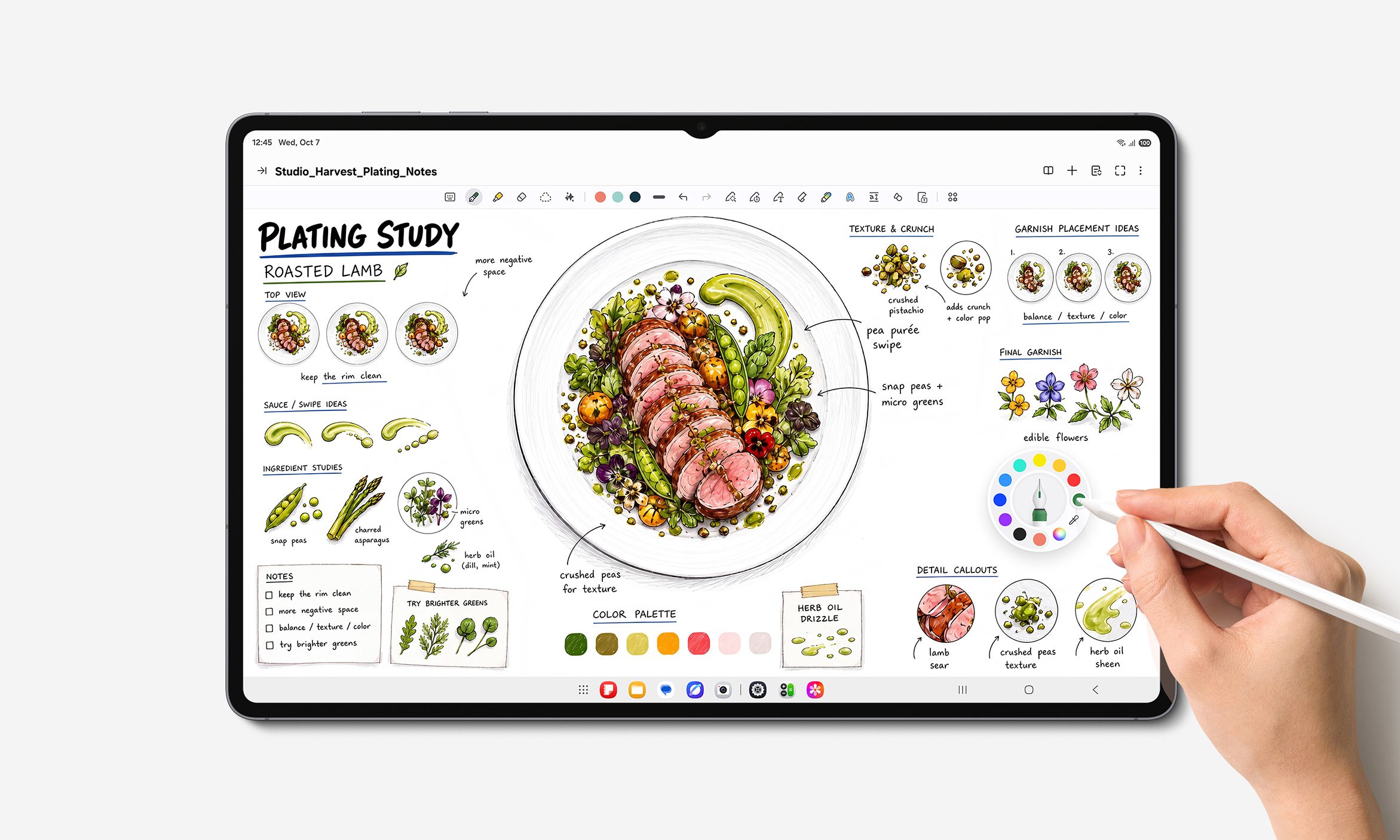
Samsung has fitted a 11,600 mAh battery inside the Galaxy Tab S12 Ultra, with support for 45W fast charging in tow. You get a 13-megapixel main camera at the back, flanked by another 8-megapixel sensor for ultrawide capture, while selfie and video calling duties are handled by a 12-megapixel front camera.
The big screen, which is tailor-made for watching videos, is assisted in its audiovisual duties by a quad speaker setup, with four-channel spatial audio support. Unlike Apple, Samsung ships the S Pen stylus in the box without any extra cost. The build is IP68 certified, and you get an in-display fingerprint sensor for authentication.
Software is where Samsung is pushing harder
Samsung says the Galaxy Tab S12 Ultra comes with an upgraded 3D vapor chamber for more efficient cooling. On the software side, the tablet comes preinstalled with Adobe Photoshop, which Samsung claims is a first-of-its-kind event on Android tablets. The tablet runs Android 17 out of the box, with One UI 9 layer on top, and a commitment of seven generations of Android OS updates, alongside a matching term for rolling out security builds.